
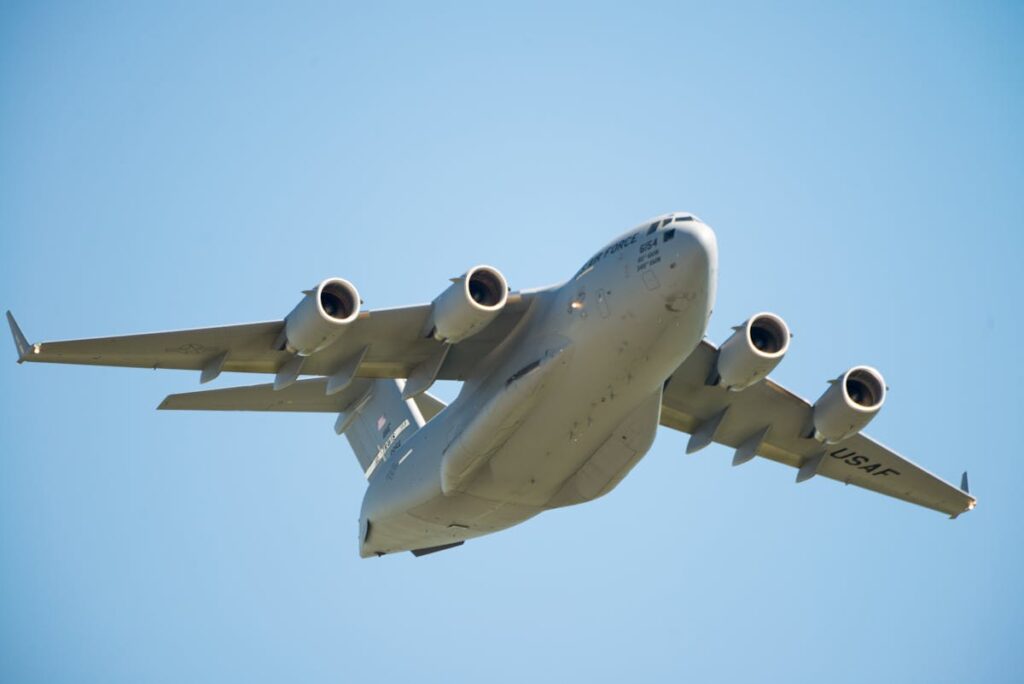
On December 12, 2025, passengers aboard JetBlue Flight 1112 came within minutes — and mere hundreds of feet — of a mid-air collision they never saw coming. As their Airbus A320 climbed toward cruising altitude over the Caribbean, a U.S. Air Force refueling tanker crossed directly into their flight path. The military aircraft was invisible to every safety system designed to prevent exactly this scenario. The reason: the tanker was flying without its transponder turned on.
This wasn’t an isolated incident. Just eleven months earlier, 67 people died when a U.S. Army Black Hawk helicopter collided with a commercial jet over the Potomac River near Washington, D.C. The helicopter’s collision avoidance system wasn’t broadcasting. Together, these two events expose a structural gap in aviation safety that has been widening for 25 years.
A danger hiding in plain sight
Our research analyzing 25 years of data (2000–2025) reveals a disturbing trend: dangerous encounters between military and civilian aircraft have increased by 300–400% in key regions around the world. The Baltic Sea, South China Sea, and now the Caribbean have emerged as hotspots where civilian passengers face elevated collision risk without ever knowing it.
Modern aviation safety relies on a simple principle: every aircraft broadcasts its position, altitude, and identity via transponder. This enables Traffic Collision Avoidance Systems (TCAS) in cockpits to alert pilots to nearby aircraft, allows air traffic controllers to track and separate traffic, and triggers automated conflict alerts before problems develop. But there is a critical flaw: TCAS cannot detect aircraft without transponders. When military aircraft disable theirs — which they are legally allowed to do for sensitive missions — they become completely invisible to civilian safety systems. Collision avoidance reverts to the 1930s-era principle of see and avoid. In the December 2025 Caribbean incident, the only reason disaster was avoided was pure luck: the JetBlue pilots happened to look out the window at the right moment and manually stopped their climb.
A legal loophole from 1944
The root of the problem lies in international law. The 1944 Chicago Convention — written before transponders even existed — exempts military state aircraft from civilian aviation regulations. The only requirement is that military aircraft show due regard for civilian safety. But due regard has no operational definition, no enforcement mechanism, and no measurable standard.
Different nations interpret it differently, creating a global patchwork of practices. The United States permits broad exemptions for sensitive government missions — which the January 2025 investigation revealed included routine helicopter training flights. Russia systematically operates without transponders in international airspace, accounting for over 300 NATO scrambles in 2023 alone. China formally requires transponders in its airspace but conducts aggressive intercepts, with more than 180 coercive and risky incidents with U.S. aircraft between 2021 and 2023.
The human cost
The statistics are alarming: 67 deaths in the January 2025 Washington collision, over 15,000 close calls between commercial aircraft and military helicopters near Reagan National Airport between 2021 and 2024, and more than 8,700 near-miss reports in the FAA database, with 23% involving military aircraft. Behind these numbers are real people — passengers on routine flights who have no idea they are sharing the sky with invisible aircraft.
The fundamental conflict is structural: military aviation exists to achieve national security objectives, which may require invisible operations. Civilian aviation exists to transport passengers safely, which requires all aircraft to be visible. No technology can reconcile these competing purposes on its own. Collision avoidance systems work perfectly — when all aircraft participate. But cooperative surveillance requires cooperation.
Legislative pressure mounts
The January 2025 collision prompted Congressional action. The bipartisan Safe Operation of Shared Airspace Act of 2025 would close transponder exemption loopholes near busy civilian airports, require enhanced collision avoidance on commercial aircraft, and end certain military exemptions in high-traffic airspace. The debate continues. Military operational security concerns clash with civilian safety demands, and the outcome remains uncertain.
For five decades, aviation authorities have warned about this risk. Technology exists to prevent these tragedies — if only all aircraft would use it. The December 2025 Caribbean incident and the January 2025 Washington catastrophe should serve as a turning point. Whether 67 lives lost, and countless passengers who narrowly escaped the same fate, will finally prompt the policy changes that decades of warnings have not remains to be seen.
Key Takeaways
- A U.S. Air Force tanker without its transponder active nearly collided with a civilian airliner over the Caribbean in December 2025.
- The January 2025 Washington, D.C. midair collision killed 67 people — the helicopter’s avoidance system was not broadcasting.
- Dangerous military-civilian aircraft encounters have risen by 300–400% over 25 years in key global regions.
- A 1944 international treaty exempts military aircraft from civilian transponder rules — with no enforceable safety standard.
- U.S. legislation is being debated that would close transponder loopholes near high-traffic civilian airspace.
Research compiled December 2025 from official aviation safety agencies (NTSB, FAA, EASA, ICAO), military publications, international organizations, and verified news sources.
Photo: Waddle Aero via Pexels