
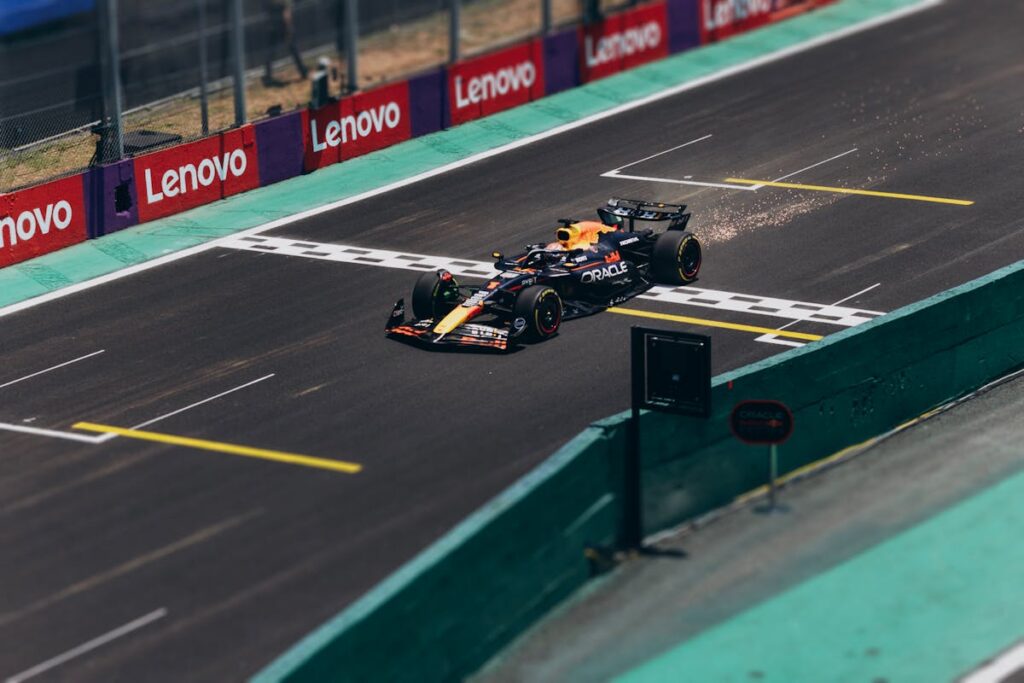
Few things in motorsport are as visceral as a Formula 1 car crossing the finish line at full speed, sparks flying from the underfloor as it scrapes the tarmac at over 300 km/h. It’s a reminder of just how close to the edge these machines operate — and how extraordinary the engineering behind them truly is. But what exactly makes an F1 car so different from everything else on four wheels? The answer lies in the intersection of aerodynamics, materials science, and relentless human ingenuity.
As someone drawn to both aerospace and motorsport, the parallels have always been hard to ignore. The obsession with performance, precision, and pushing the boundaries of what’s physically possible runs through both worlds like a current. Whether it’s a rocket nozzle or a diffuser, the pursuit is the same: extract maximum performance from minimum resources, and do it reliably, lap after lap, race after race.
Aerodynamics as a superpower
The most counterintuitive fact about a modern F1 car is that it generates more downforce than it weighs. At racing speeds, the aerodynamic load pressing the car into the tarmac exceeds the car’s own mass — which means that, in theory, an F1 car could drive upside down on the ceiling of a tunnel and stay there. This downforce allows the car to corner at forces that would render a normal person unconscious, with lateral g-loads regularly exceeding 5g in the fastest corners.
Every surface on the car is shaped to manage airflow. The front wing splits incoming air, directing it under the floor and around the tyres. The floor itself generates the majority of the downforce through a phenomenon called ground effect — the faster air moves under the car, the lower the pressure it creates, sucking the car toward the ground. The rear wing adds further load but comes at a cost in drag, and finding the right balance between the two is one of the central challenges of car setup. In 2026, with active aerodynamics now part of the regulations, the wings themselves move — flattening on straights to reduce drag, pitching back in corners to maximize grip. It’s as close to aerospace engineering as road racing has ever come.
Materials that bend physics
An F1 car’s chassis — the survival cell that protects the driver — is built from carbon fibre composite. It’s a material that weighs a fraction of steel while being significantly stronger under the right loads, and it can be layered and oriented to be stiff in some directions and flexible in others with extraordinary precision. The result is a structure that can survive impacts that would crumple conventional materials, while remaining light enough that the entire car sits below the minimum weight limit without ballast.
Weight is everything in F1. Every gram removed from one component can be redistributed as ballast to improve the car’s balance. Engineers spend months shaving fractions of a gram from brackets, fasteners, and body panels that most people will never see. The brake discs, made from carbon-carbon composite, operate at temperatures above 1,000°C and can bring the car from 300 km/h to a standstill in around 100 metres — a deceleration violent enough to push a driver forward at 6g in their harness.
The driver inside the machine
All of this engineering exists in service of one goal: letting the driver go faster. And the demands placed on F1 drivers are themselves remarkable. Over the course of a race, a driver might make 3,000 steering inputs, manage tyre temperatures and fuel loads through their throttle application, respond to strategy calls from the pit wall, and monitor dozens of parameters on their steering wheel — all while sustaining g-forces that make the act of holding their head upright a physical effort.
The mental and physical workload is closer to that of a fighter pilot than a conventional athlete. Neck muscles that can handle 6g lateral loads, reaction times measured in milliseconds, and the ability to process information under extreme physical stress — these are the human components of the system. The car is only as fast as the person steering it.
Engineering at the limit
What makes F1 extraordinary is not any single technology but the totality of the system — thousands of components, each optimised to the edge of what’s possible, working together within a tight regulatory framework. Teams spend hundreds of millions of euros each year searching for fractions of a second. Sometimes the gain comes from a new aerodynamic concept; sometimes it’s a software update to the energy recovery system; sometimes it’s simply a driver who can carry more speed through a particular corner. The stopwatch doesn’t care how you found the time. It only measures whether you did.
Key Takeaways
- F1 cars generate more aerodynamic downforce than their own weight, allowing cornering forces above 5g.
- Carbon fibre composite gives the chassis strength far exceeding steel at a fraction of the weight.
- Carbon-carbon brake discs operate above 1,000°C and can stop the car from 300 km/h in around 100 metres.
- Drivers manage thousands of inputs per race while sustaining physical loads comparable to fighter pilots.
- The 2026 regulations introduce active aerodynamics — moving wing surfaces that adjust between straights and corners.
Photo: Jonathan Borba via Pexels