
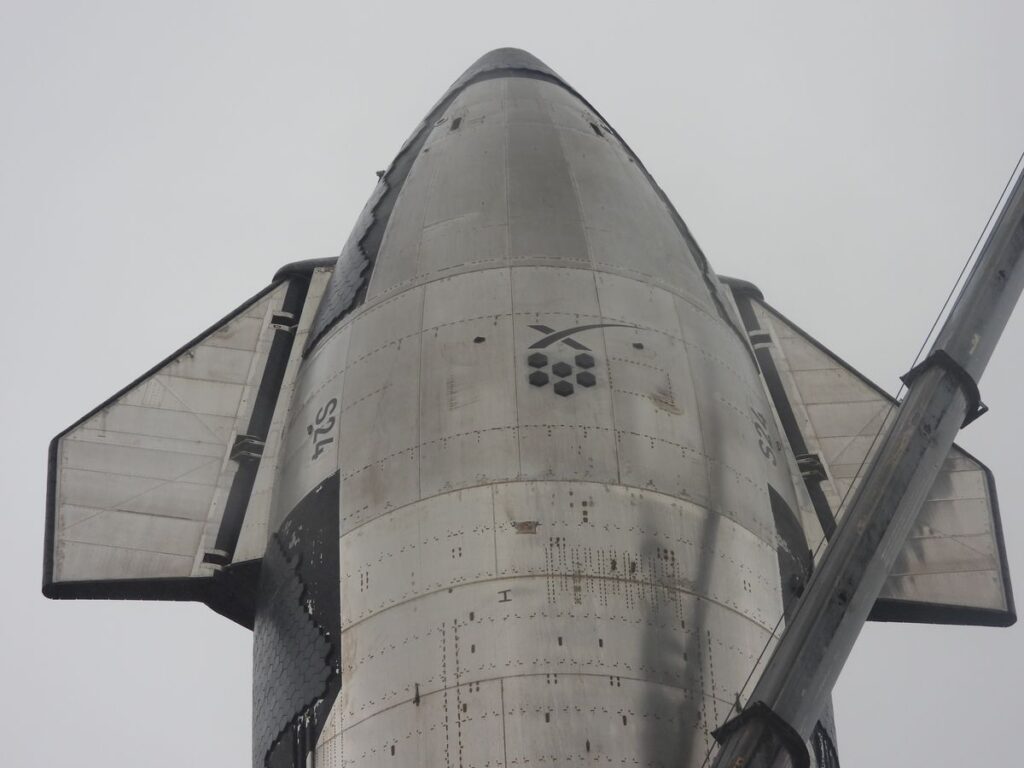
On July 24, 2026, SpaceX launched the thirteenth full-stack test flight of Starship from Starbase, Texas. What followed was, by most measures, the most successful Starship flight yet. What followed after that was something almost nobody expected: a three-week maritime salvage operation in one of the most remote stretches of ocean on Earth, ending with a battered but intact rocket parked off a tiny Australian island best known for its crabs.
A Flight That Refused To Explode
Flight 13 was not a routine outing. SpaceX deliberately pushed the vehicle through a higher dynamic pressure profile than previous flights, stress-testing the heat shield’s roughly 18,000 hexagonal tiles under harsher conditions than a normal mission would require. Booster 20 lit all 33 engines for its boostback burn for the first time on a Version 3 vehicle, though its landing burn only partially relit and it hit the Gulf of America hard. Ship 40, the upper stage, performed close to flawlessly: it deployed 20 Starlink V3 satellites, completed an in-space Raptor relight, survived reentry, and splashed down softly in the Indian Ocean.
SciNews — raw footage of Ship 40’s reentry and splashdown on July 24, confirming SpaceX’s stated mission parameters for the Indian Ocean landing.
What made this splashdown different from every one before it is simple: Ship 40 did not explode. Every previous Starship that reached the ocean either broke apart or detonated shortly after touchdown. This one stayed in one piece, stayed upright, and kept transmitting telemetry for hours afterward, even with its antennas partly submerged.
NASASpaceflight — a technical rundown of the Flight 13 launch and reentry, including the abort investigation, Ship 40’s flawless ascent burn, and a first look ahead to Flight 14.
From Spacecraft To “Star Boat”
Once Ship 40 was floating, the problem stopped being aerospace engineering and became naval salvage. Three vessels were dispatched from Dampier, Western Australia: the anchor-handling tug Normand Ranger, the support vessel Go Australis, and Skimmer Tide, which carried fendering equipment. The plan was to tow the vehicle roughly 750 to 850 nautical miles back to port.
The trouble was physics. Starship is extraordinarily light for its size, so it rides high on the water and gets pushed around by wind far more than by current. With no hard points designed for towing, crews could not simply hook a line to the hull. Instead, they encircled the vehicle with a ring of large Yokohama fenders, essentially lassoing it, and used that soft cushion to begin pulling it toward Dampier. Progress was slow, often under two knots, and satellite imagery through early August showed the fleet struggling to make headway against wind and swell.
Then the weather turned. Rough seas forced the crew to release the fender ring entirely, leaving Ship 40 adrift and loose for a period while Normand Ranger made a supply run to the nearest landfall: Christmas Island, a remote Australian territory in the eastern Indian Ocean, south of Java. At that point, the original plan to reach Dampier was effectively abandoned in favor of the nearest safe harbor.
A Riskier Pull To Christmas Island
With the fender-and-lasso method no longer working in worsening conditions, the recovery crew opted for something considerably more direct and considerably riskier: rigging a tow line straight onto one of Ship 40’s Raptor engine nozzles. That approach risks tearing the mount or opening the hull to flooding, but with calmer weather briefly available, the crew judged it worth the gamble. It worked. Normand Ranger and Go Australis brought the vehicle in on August 18, mooring it off the northern, lee shore of Christmas Island.
What’s Going on With Shipping? — host Sal Mercogliano tracks the fleet’s AIS data to reconstruct the final tow, the switch to a riskier direct line on a Raptor nozzle, and the arrival at Christmas Island.
Photos released by SpaceX show visible damage where the fenders rubbed against the hull, abrading heat shield tiles near the bow, along with at least one forward fin that appears to have come loose or been removed. Christmas Island itself has only modest infrastructure: an airport and a small bulk-loading facility, but nothing resembling a heavy-lift crane. That leaves SpaceX with a narrower set of options for the next leg. A geared cargo vessel equipped with its own heavy-lift cranes is the most plausible route home, capable of hoisting the roughly 100-ton, 140-foot vehicle onto its deck for the voyage back. A full semi-submersible heavy-lift ship, by contrast, would likely be overkill for a vehicle this size. On-site disassembly, cutting the vehicle apart and shipping it out in pieces, remains a fallback if a suitable lift vessel cannot be arranged.
What The Wreck Can Teach Engineers
Whatever happens next, Ship 40’s survival already represents a genuine first for the program: it is the first Starship upper stage ever recovered in a largely complete, inspectable state after a full flight to the edge of space and back. Telemetry can tell engineers when a sensor registered a temperature spike or a structure flexed, but it cannot show the full physical picture. A recovered vehicle can be measured, photographed and sampled directly. That matters most for the heat shield, widely regarded as the hardest unsolved problem in making Starship rapidly reusable. Engineers will be able to examine tile attachment points, map abrasion patterns across the roughly 18,000 hexagonal tiles, inspect flap hinges and edges, and look for weld distortion, all in far greater detail than remote sensors and onboard cameras allow. By most early assessments, tile loss during the flight itself was minimal, with the visible damage concentrated in the areas the salvage fenders rubbed against during the tow. Some former NASA heat shield engineers have separately argued that a ceramic tile system, however well it performed here, is inherently inspection-heavy and may cap how quickly Starship can be turned around between flights, a debate the data from this recovery will likely feed into either way. For now, the more immediate story is a rocket that was supposed to sink, and instead became a maritime salvage case study playing out in real time, one improvised decision at a time.
Key Takeaways
- Ship 40 became the first Starship upper stage ever recovered largely intact after a full flight, surviving splashdown instead of exploding or breaking apart.
- The vehicle’s light weight and lack of towing hard points forced an improvised salvage using Yokohama fenders before crews switched to a riskier direct tow on a Raptor nozzle.
- Rough weather forced a change of plan mid-voyage, diverting the tow from the original target of Dampier, Australia, to the nearer Christmas Island.
- Visible damage is concentrated where fenders rubbed against the hull; the heat shield itself reportedly lost very few tiles during the flight and reentry.
- A direct physical inspection of the heat shield, welds and flap hinges could yield engineering data that telemetry alone cannot capture, feeding directly into the debate over how quickly Starship can be turned around for reuse.
Video timeline, in chronological order:
- Starship launch and Super Heavy landing, 24 July 2026 — SciNews, Jul 24
- Starship reentry and landing, 24 July 2026 — SciNews, Jul 24
- Ship 40 Survived! SpaceX Prepares for an Ambitious Flight 14 — NASASpaceflight, Jul 27
- Starship May Be Recovered? Starliner Might Fly Again? Deep Space Updates July 29th — Scott Manley, Jul 30
- Salvaging SpaceX’s Starship: The Challenges of an Open Ocean Tow — What’s Going on With Shipping?, Jul 31
- Space X’s Starship 40: The Voyage Home — What’s Going on With Shipping?, Aug 2
- Can They Save Starship 40? The Salvage Mission — What’s Going on With Shipping?, Aug 4
- “SAL”vage Palooza: Ten Ongoing Salvage Missions & Starship 40 Update — What’s Going on With Shipping?, Aug 12
- Starship Still Lost At Sea, China’s Rocket Gets Bent, Rocket Lab’s Ghost — Scott Manley, Aug 15
- SpaceX’s Starship 40: The Arrival at Christmas Island — What’s Going on With Shipping?, Aug 18
Photo: Space Ocean Corp via Pexels