
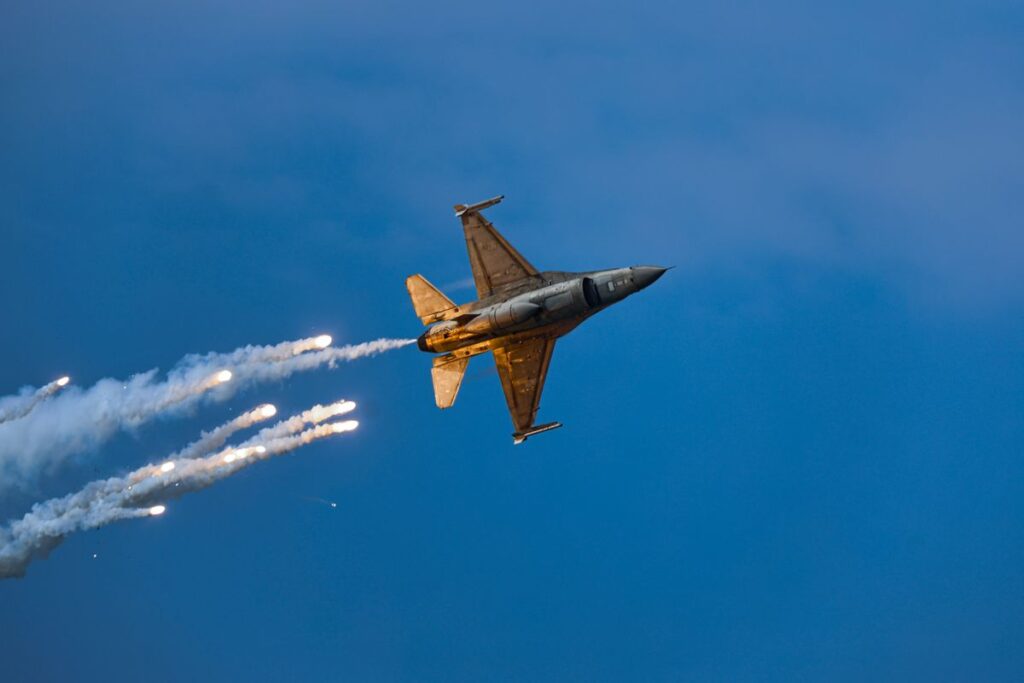
When Ukraine’s F-16s finally arrived in 2024, the expectation was that they would tip the balance in the sky. Four years into the war, a new assessment from RUSI airpower analyst Justin Bronk, discussed in a recent interview on The Mooch Report, tells a different story. The most consequential weapons in Ukraine’s air war today aren’t fighter jets at all — they’re truck-mounted machine guns, homemade drone interceptors, and belts of cheap anti-aircraft systems strung across the country. This is a war being decided by attrition and production capacity, not air superiority.
The Real Front Line Is a Drone Wall
Russia now launches hundreds of one-way attack drones per week, alongside waves of cruise and ballistic missiles. Ukraine’s answer has been to build deep belts of mobile air defense teams stretching back from the border — machine guns and autocannons on pickup trucks, shoulder-fired missiles, and thousands of improvised drone interceptors, many of them 3D-printed and running basic machine-learning guidance for the final approach. These systems now account for the majority of Russian drones shot down, and they’re dramatically cheaper per intercept than firing a half-million-dollar air-to-air missile at a target that costs a fraction of that to build.
What the F-16s Actually Delivered
The F-16 record is real but narrower than the early hype suggested. Ukrainian pilots have destroyed well over 2,500 Russian drones and shot down multiple cruise missile salvos, and in July 2026 an F-16 achieved the first confirmed air-to-air kill of a Russian Su-35 fighter of the war. But that success has come at a steep cost: every hour spent chasing drones burns through a fighter’s finite airframe life before it needs factory-level maintenance, and Russia can produce far more drones per month than any fighter fleet could ever intercept. The jets have not solved Ukraine’s biggest problem — Russian Su-34 bombers dropping glide bombs from beyond the F-16s’ missile range.
Russia Is Stretched Thin Too
The strain runs both directions. Ukrainian long-range strike drones are increasingly hitting Russian oil and gas infrastructure deep inside the country, forcing Russia to disperse its own air defenses over a vast territory instead of concentrating them near the front. That dispersal is quietly opening gaps elsewhere, giving Ukrainian forces more room to maneuver near the front lines than was possible earlier in the war.
A Possible Fix Is Still a Year Away
Sweden’s Gripen fighters, expected to join the Ukrainian Air Force in early 2027, carry the long-range Meteor missile — a weapon that could finally let Ukrainian pilots reach Russian bombers currently operating safely out of range. Until then, the glide bomb threat remains largely unanswered.
Four years on, this looks less like a conventional air war and more like a 21st-century trench war fought with drones instead of rifles — a grinding contest over who can sustain personnel, ammunition, and production the longest.
Key Takeaways
- Cheap, mobile air defense — not fighter jets — now shoots down most Russian drones.
- Ukraine’s F-16s have downed thousands of drones and even a Russian Su-35, but haven’t cracked Russia’s glide bomb campaign.
- Both sides are overstretching their air defenses trying to cover ever-wider territory.
- Interceptor missile shortages are a global problem, worsened by recent US and Gulf State use against Iranian attacks.
- Swedish Gripen jets with Meteor missiles, arriving in early 2027, may finally close the glide bomb gap.
Further Reading
Photo: Eterna Media via Pexels