
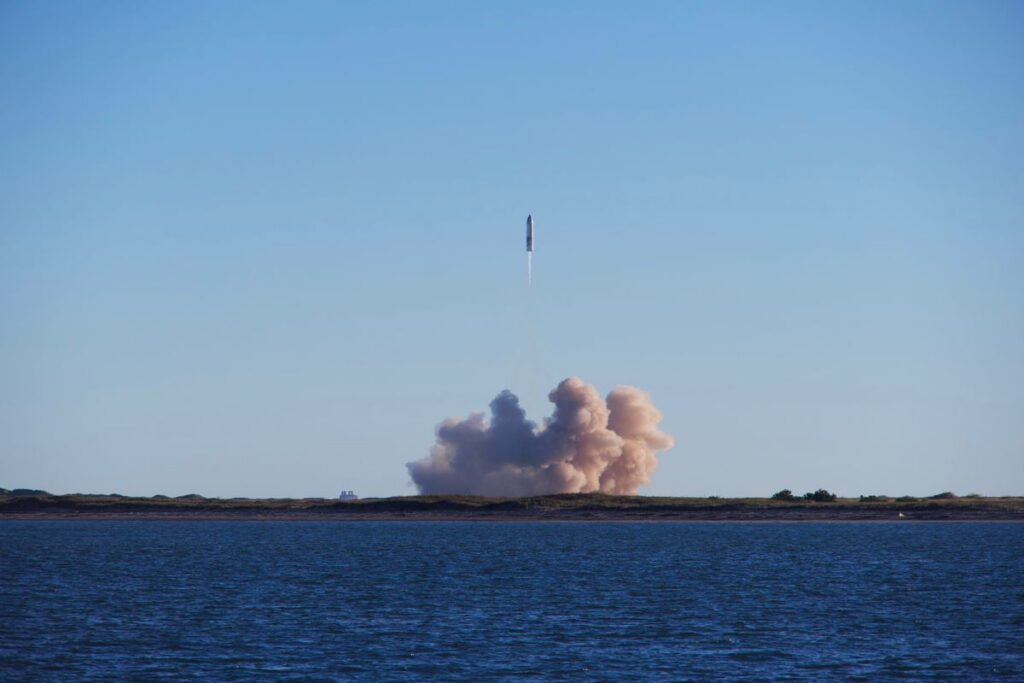
On 28 September 2008, a small rocket called Falcon 1 reached orbit on its fourth attempt, after three failures. It was the first privately developed rocket running entirely on liquid fuel to do so. Exactly 18 years later, SpaceX’s Starship, the largest rocket ever built, has done the same.
A Long Road to Orbit
Flight 14 lifted off from Starbase, Texas, on 28 September 2026. Earlier test flights stopped just short of orbit on purpose. Starship’s upper stage is so large that SpaceX wants proof it can return under control before leaving it in space. This time the ship reached orbit about 26 minutes after liftoff, at roughly 270 kilometres.
A Problem Mid-Flight
One engine shut down during ascent. Mission controllers first announced there would be no orbital burn, then reversed after about eight minutes of review. The booster made a soft splashdown in the Gulf.
The First Real Payload
Starship released 26 Starlink V3 satellites one by one, its first operational payload. Each V3 is designed to add about one terabit per second of network capacity, so the batch adds roughly 26 terabits per second. According to SpaceX, that is about ten times what a Falcon 9 adds with a load of older V2 Mini satellites.
This comparison is about capacity, not about the rocket. A V3 satellite is far more capable than a V2 Mini, and it is also too large for Falcon 9, which is why it needs Starship. A full Starship load of up to 60 V3 satellites would add about twenty times the capacity of a Falcon 9 launch.
Because it was daylight, cameras on the satellites filmed the deployment in colour. Out of caution over the engine, SpaceX cut the planned 10-hour, six-orbit mission to about three hours. The ship re-entered and splashed down in the northern Pacific.
Watch the Full Story
Video: “Orbit Day – Starship Finally Takes A Big Leap” by Scott Manley (contains a short sponsor segment).
Falcon 1 carried a 165 kg dummy payload. Starship carried 26 operational satellites. That 2008 success also came just before NASA awarded SpaceX a $1.6 billion contract to resupply the International Space Station. Whether the engine issue affects the two flights planned for October is still open.
Key Takeaways
- Starship reached orbit for the first time on 28 September 2026, exactly 18 years after Falcon 1.
- All 26 Starlink V3 satellites were deployed successfully, adding roughly ten times the capacity of a typical Falcon 9 Starlink launch.
- An engine shutdown cut the flight from about 10 hours to about 3.
- October’s flight schedule may be affected.
Photo: Forest Katsch via Pexels