
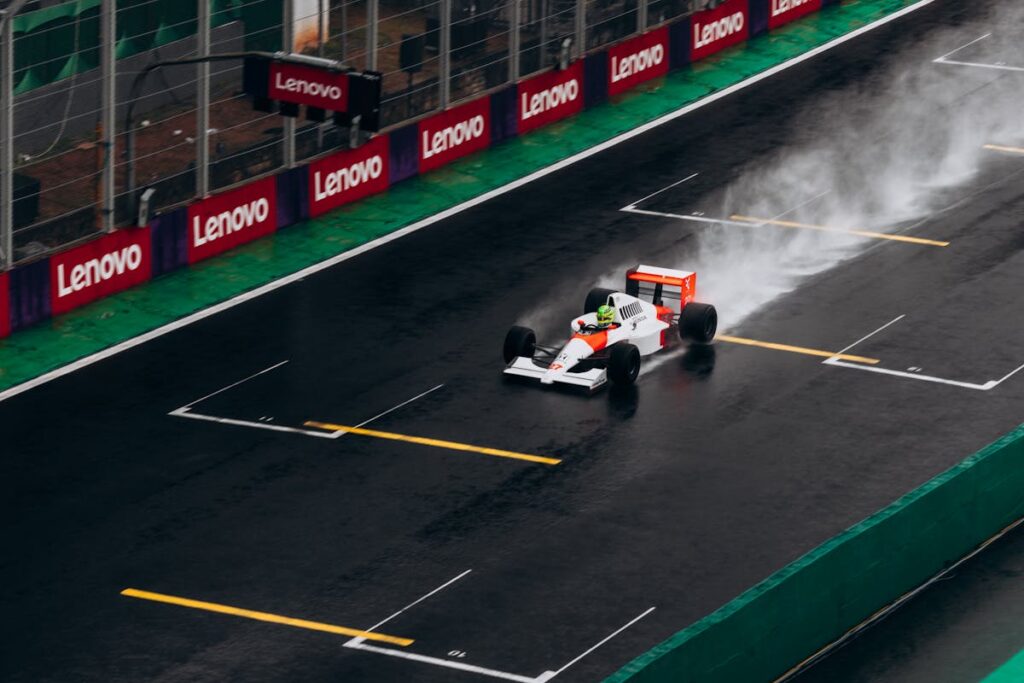
The 2026 Formula One season is underway, and if the Australian Grand Prix at Albert Park was anything to go by, the new era promises spectacle, drama, and more than a few surprises. George Russell converted pole position into victory for Mercedes, with team-mate Kimi Antonelli right behind him for a Silver Arrows 1-2. Ferrari’s Charles Leclerc and Lewis Hamilton followed in third and fourth, while reigning champion Lando Norris could only manage fifth on a weekend that belonged firmly to Mercedes.
On paper, it was a cracking race — seven lead changes in the opening 10 laps, chaotic strategy calls under two Virtual Safety Cars, and even Oscar Piastri crashing his McLaren on the sighting lap before the race had even started. There was plenty to talk about. But watching the action unfold in Melbourne, a question kept nagging at me: is this still the raw, visceral motorsport we fell in love with?
A new technical era
The 2026 regulations represent the most sweeping overhaul Formula One has seen in years. The power units now split energy delivery equally — 50% from the internal combustion engine and 50% from electrical systems. Active aerodynamics have been introduced, shifting drag and downforce dynamically depending on speed and deployment needs. Three new engine manufacturers — Audi, Honda (with Aston Martin), and Ford (backing Red Bull Powertrains) — entered the sport, and an eleventh team, Cadillac, made its debut on the grid.
The ambition is clear: cleaner, more efficient, more technologically advanced racing. And to be fair, the engineering achievement on display in Melbourne was staggering. Multiple teams brought genuinely competitive cars to the opening round, and the midfield was tighter than it has been in years.
Energy management dominates
Here is where my enthusiasm gets tempered. Throughout the Melbourne weekend, drivers repeatedly mentioned that managing energy deployment was not just a part of racing in 2026 — it was the dominant factor. With the 50-50 power split, a driver’s ability to attack, defend, or even simply hold position depends heavily on how much electrical energy they have available at any given moment.
The early laps of the race illustrated this vividly. Russell and Leclerc swapped the lead multiple times — not always because one driver out-braked the other or carried more speed through a corner, but because the closing speeds created by the electric deployment made overtaking almost automatic in certain moments. Russell himself described yoyoing back and forth with the lead, barely able to predict the next move. Leclerc said he was living on his wits, reacting to movements he could barely anticipate.
And this is exactly the concern. The hard, committed late-braking move — a driver throwing everything into a corner, trusting grip and nerve over energy management — is one of the most exciting things in motorsport. When that is replaced or diluted by algorithmic deployment decisions and energy harvesting windows, something fundamental changes about what we are watching.
Racecraft or system management?
Several drivers acknowledged during the Melbourne weekend that they were still learning the cars’ energy systems on the job, even after extensive pre-season testing. Verstappen — who started 20th after a Q1 crash — drove a genuinely impressive recovery race to sixth, but even he was constrained by what the power unit allowed him to do lap by lap.
The concern is not that technology has entered Formula One. Technology has always been part of the sport. The concern is about the balance: when the energy management system becomes the primary determinant of who can attack and who cannot, the human element — the instinct, the bravery, the late-apex commitment — risks being reduced to a secondary factor.
Some will argue that managing complex systems is itself a skill, and they are right. But there is a difference between a driver who is technically brilliant and a driver who is fast and fearless under pressure. Formula One has always celebrated both. The question for 2026 is whether the new regulations give room for the latter to shine.
Reasons for cautious optimism
To be fair, Melbourne was race one. Teams were conservative, still learning, still finding the edges of what their power units and aerodynamic systems can do. It would be premature to write off 2026 as the season pure racing died. Mercedes clearly brought the strongest package to Australia, and as the competitive order shifts across the year, we may see more genuine wheel-to-wheel battles emerge.
Ferrari’s race pace was encouraging. Norris, despite a difficult weekend, leads a McLaren team that will surely be stronger. And the midfield — Haas, Racing Bulls, even Audi on debut — showed real promise. There is talent and competition here. The raw material for great racing exists.
But Formula One’s governing body, the FIA, and the sport’s commercial leadership would do well to listen to what drivers are saying on team radio and in post-race interviews. When multiple drivers describe overtaking as feeling artificial, that is a signal worth taking seriously. Racing should feel earned, not harvested.
The 2026 Australian Grand Prix was entertaining, dramatic, and technically impressive. George Russell and Mercedes deserved their victory, and the season ahead looks competitive on paper. But as a motorsport fan, I find myself hoping that the pure racing — the late-braking duel, the commitment under pressure, the driver instinct that no algorithm can replicate — does not quietly fade into the background as teams optimise their energy deployment strategies. Formula One is at its best when the machine serves the driver, not the other way around. Melbourne raised the question. The rest of the season needs to answer it.
Key Takeaways
- George Russell won the 2026 season opener for Mercedes, with Kimi Antonelli second and Charles Leclerc third.
- The new 50-50 ICE/electric power split and active aerodynamics dominated discussions among drivers all weekend.
- Several drivers described overtaking as feeling artificial due to energy deployment dynamics.
- Max Verstappen recovered from 20th to sixth; Oscar Piastri did not start after crashing on his sighting lap.
- The key question for 2026: will the new regulations allow pure driver racecraft to shine, or will energy management dominate?
Photo: Jonathan Borba via Pexels