
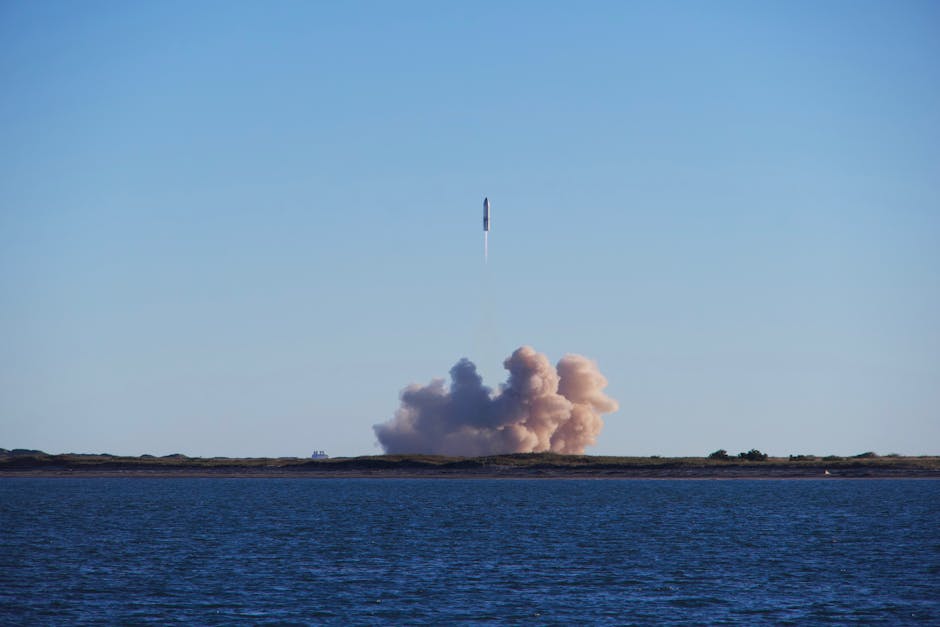
A Ukrainian parliamentary committee chair gave an interview this week that made headlines across European media: during the war, Ukraine secretly fired two rockets into space, air-launched a missile from a transport aircraft at 8,000 metres altitude, and has missiles capable of hitting targets 500 kilometres away at hypersonic speed. The Austrian daily derStandard ran the story under the headline “Ukraine launches two rockets into space and starts secret Star Wars programme,” drawing on an interview published by RBC-Ukraine on 13 April 2026 with MP Fedir Venislavskyi. It is a gripping read. It is also, in several important places, wrong.
Ukraine’s wartime innovation in defence technology is genuinely remarkable — arguably one of the most impressive military-industrial stories of the decade. That makes accurate reporting more important, not less. When claims are exaggerated or go unchecked, they undermine the credibility of real achievements. So let us go through the key claims one by one.
Claims at a Glance
| Claim | Verdict |
|---|---|
| Air-launch “done only once before, in the 1970s in the USA” | ❌ False |
| Ukrainian missiles described as “hypersonic” | ⚠️ Misleading |
| Sich-2-30 satellite to reach orbit “in December” | ❌ False — deorbited Oct 2025 |
| Second Oreshnik strike on Lviv, Jan 2026 | ✅ Broadly accurate |
| 204 km altitude implies satellite launch capability | ⚠️ Misleading — suborbital ≠ orbital |
| Ukraine among “ten countries” with space technologies | ⚠️ Misleading |
| All claims from one politician, no corroboration | 🔴 Critical sourcing failure |
The Air-Launch Claim Is Flatly Wrong
The article states that launching a rocket from a transport aircraft in flight “has only been performed once before — in the 1970s in the USA.” Reading the original RBC-Ukraine interview, it is clear this claim comes directly from Venislavskyi himself, who is quoted saying: “This was done for the first time on the European continent and only the second time in world history. The United States first achieved this in the mid-1970s.” derStandard faithfully reproduced what the MP said. That is precisely the problem: a journalist’s job is to check a claim like that before publishing it — not pass it through unchallenged.
Because the claim is not a matter of interpretation — it is demonstrably false. Air-launching rockets has been routine practice for nearly eighty years. The U.S. Bold Orion programme fired twelve rockets from B-47 bombers between 1958 and 1959, including the first air-launched rocket to reach space. The American Pegasus rocket, built by Orbital Sciences, completed forty-five orbital launches from a carrier aircraft between 1990 and 2021 — placing roughly a hundred satellites into orbit. Virgin Orbit’s LauncherOne rocket, dropped from a converted Boeing 747, reached orbit four times between 2021 and 2023, including once from Cornwall in the United Kingdom. Russia’s Kinzhal missile, used in combat against Ukraine since 2022, is itself air-launched from a MiG-31 fighter jet.
If Ukraine has successfully air-launched a rocket from a transport aircraft, that is a meaningful technical milestone for the country — but it is not a world first, or even close to one. Framing it as such misleads readers and, ultimately, sets Ukraine up for embarrassment when the facts are checked.
“Hypersonic” Is Doing Too Much Work
The article quotes the MP describing Ukrainian missiles as flying at “hypersonic speed.” To its credit, the article then adds a caveat: conventional ballistic missiles also exceed Mach 5, which is the threshold commonly associated with hypersonic flight. But having made that point, the article continues to use “hypersonic” as though it were a meaningful distinction.
In defence and aerospace, a hypersonic weapon means something specific: a system that sustains controlled, manoeuvrable flight within the atmosphere at Mach 5 or above — a hypersonic glide vehicle or a scramjet-powered cruise missile. These are genuinely difficult to intercept because they do not follow a predictable ballistic arc. A standard ballistic missile, by contrast, peaks above the atmosphere and falls back in a predictable curve. It briefly exceeds Mach 5 on the way down — as the World War II-era V-2 did — but that does not make it a hypersonic weapon in any meaningful technical sense.
Ukraine almost certainly does field capable new ballistic missiles with ranges around 500 kilometres. That is worth reporting clearly and accurately. Calling them hypersonic adds a buzzword at the cost of precision.
A Satellite That Has Already Gone
The article describes the “Sich 2-30” as the first purely Ukrainian reconnaissance satellite, set to reach orbit “in December.” This is recycled information — and factually wrong. Sich-2-30 was launched on 13 January 2022, aboard a SpaceX Falcon 9 rocket. It never achieved stable attitude control after reaching orbit, and it burned up during atmospheric reentry between 6 and 10 October 2025, according to a formal note submitted by Ukraine’s Permanent Mission to the United Nations Office for Outer Space Affairs. The satellite is gone. The passage the article seems to be drawing from dates to statements made by a Ukrainian deputy prime minister in late 2021, before the launch even took place.
This kind of error — a quote recycled without a date check — is one of the more common failures in fast-moving news coverage. Here it transforms a historical milestone into an apparent upcoming event.
One Source, No Corroboration
Every major claim in the article traces back to a single interview with Fedir Venislavskyi, a Ukrainian MP and lawyer who chairs a parliamentary defence subcommittee. He is not an engineer, not a space agency official, and not a military spokesperson. There is no corresponding statement from Ukraine’s military intelligence directorate (the GUR), the State Space Agency, the Ministry of Defence, or the Office of the President. Reuters, the BBC, the Financial Times, and the Kyiv Independent — outlets that cover Ukraine’s defence sector closely — have not reported the specific technical claims.
The article also implies, through the framing of the rocket launches, that Ukraine now has the capability to launch satellites independently. Reaching 204 kilometres in altitude is impressive for a wartime programme — but altitude alone does not get a satellite into orbit. To stay in orbit, an object also needs to be travelling sideways at roughly 7.8 kilometres per second. That horizontal velocity requires an enormous amount of additional energy — roughly fifteen to thirty times more than a straight-up suborbital shot to the same height. Ukraine has not demonstrated an indigenous orbital launch from its own territory. To imply otherwise does a disservice to readers trying to understand what Ukraine has actually achieved.
Key Takeaways
- Ukraine’s wartime defence innovation is real and impressive — but several specific claims in the derStandard article do not hold up to scrutiny.
- The false air-launch claim originates with MP Venislavskyi himself — which makes the editorial failure clearer, not smaller. Journalists are expected to verify what their sources tell them.
- Calling ballistic missiles “hypersonic weapons” conflates speed with a specific technical category. Every ballistic missile briefly exceeds Mach 5.
- The Sich-2-30 satellite described as an upcoming mission deorbited and burned up in October 2025. The passage appears to recycle a quote from 2021.
- All major technical claims trace to a single politician with no independent corroboration from Ukrainian defence institutions or Western outlets.
Photo: Forest Katsch via Pexels