
Shanghai delivered two races in one. On the surface, genuine drama — close battles, retirements, and a dominant Mercedes. Just below the surface, a deeper and more uncomfortable question: what kind of sport has Formula 1 become in 2026?
A Race of Two Stories
The Chinese Grand Prix was entertaining, no question about it. Kimi Antonelli converted pole into victory, managing a strong Ferrari start and a mid-race safety car before building a comfortable winning margin. George Russell completed a Mercedes one-two. Both Aston Martins retired, and McLaren didn’t even make the grid, Norris and Piastri both out with power unit failures before the formation lap.
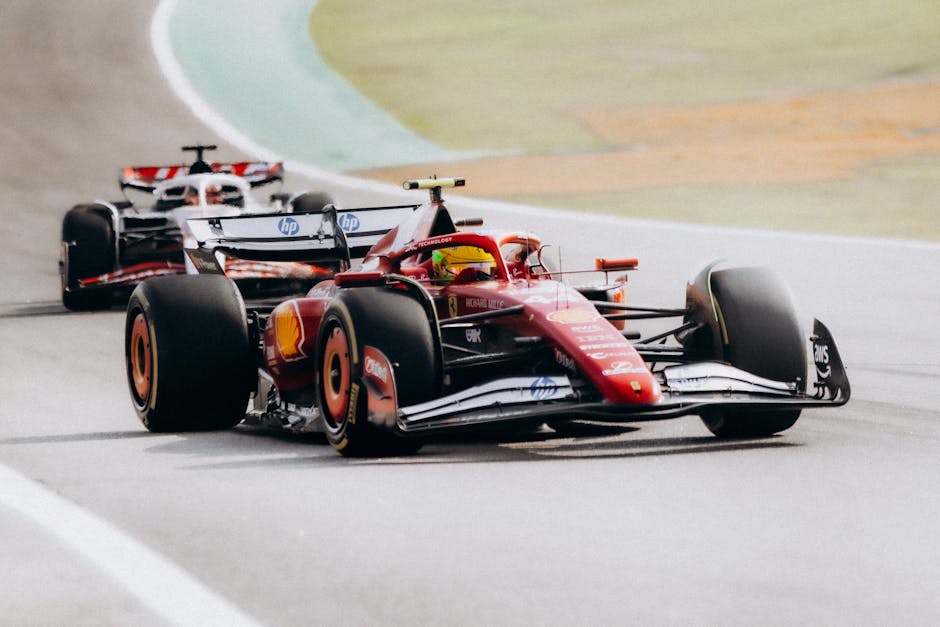
The highlight of the afternoon was the battle between Lewis Hamilton and Charles Leclerc. These two gave us exactly what we want from Formula 1 — hard, sustained, wheel-to-wheel racing between teammates who left each other just enough room but not an inch more. Committed defending, precise attacking, fair throughout. Hamilton eventually got the upper hand to claim his first Ferrari podium, but Leclerc pushed him every single lap. That duel alone was worth the admission.
And yet the dominant story coming out of China wasn’t the result. It was Max Verstappen — retired with a power unit failure of his own — and what he had to say about the racing product itself. You can read his full comments in the Autosport interview here, and the full race report is here.
Verstappen’s Verdict
Verstappen didn’t moderate his language in Shanghai. Anyone who enjoys these rules, he said, doesn’t understand racing. He compared it to Mario Kart — boost past on one straight, run out of battery, get passed back on the next. He called it a joke, the rules fundamentally flawed. Hard words, but they’re hard to dismiss from a driver who insists he’d say the same thing if he were winning every race.
Fun to Watch — But Is It Racing?
And here is my honest take. The Hamilton–Leclerc battle was great craftsmanship — but even that duel was shaped by energy deployment and recuperation. The passes happened when one driver had the electrical advantage at the right moment. It was still beautiful racing to watch, skilled and hard-fought. But underneath the theatre, the same energy-driven mechanism was at work as in every other overtake in the race. The yo-yo pattern Verstappen describes is real: boost, pass, deplete, get passed back. Watch the cars visibly slow on the straight as they harvest and you’ll see it plainly.
None of this means the new Formula 1 is bad. Quite the opposite — I’m genuinely excited about the 2026 season, about the new power unit architecture, about the technology these teams are developing, and about the unpredictability this regulation reset has introduced. The field feels more open, the racing is busy, and there is real spectacle on track. From a pure entertainment standpoint, it delivers.
There is, however, one early and somewhat inconvenient truth: Mercedes is already well ahead of everyone else. Two races in, two wins, and it wasn’t close at the front. They did an outstanding job developing to the new regulations, and right now the rest of the field is playing catch-up. That competitive imbalance could temper the excitement fairly quickly if it persists — the best regulation resets are the ones that scramble the order without simply handing dominance to a different team.
But my deeper concern is a longer-term one. The fundamental act of overtaking — one driver proving himself better through a braking zone, committing deeper, holding a tighter line — has been partially replaced by energy state management. Who has juice, passes. Who has run dry, yields. That is a different kind of competition. It rewards different skills. And I worry that when the novelty wears off, when the hype of a new era fades, what remains may not fully satisfy the audience the sport has built over decades. The purist dimension of F1 — the thing that made it compelling to serious racing fans long before Drive to Survive — is quietly being diluted. That’s worth watching carefully as the season unfolds.
My View on the Essence of Racing
From the driver’s seat, racing is one relentless pursuit: extracting every last tenth — lap after lap, wheel to wheel.
Every corner is a conversation between instinct and the absolute edge of physics. Braking later, carrying more speed, committing deeper than feels possible. The car becomes an extension of your body.
When another driver is alongside you, the demand for perfection intensifies. There’s no room for a lazy apex, a hesitant brake point, a lost tenth through a fast sweeper. Every mistake is immediately punished — not just by the clock, but by the car that was right behind you suddenly being right beside you.
The fastest drivers share one quality: an almost violent commitment to maximizing every single element simultaneously — entry speed, rotation, throttle application, exit. Nothing wasted. Nothing left on the table. Smooth but aggressive. Precise but relentless.
Lap after lap, the question never changes: Was that everything the car had? Was that everything I had? The answer is almost never yes. And that gap — between what was and what’s possible — is what drives you back to the limit every single time.
Photo: Jonathan Borba via Pexels (2025 season)