
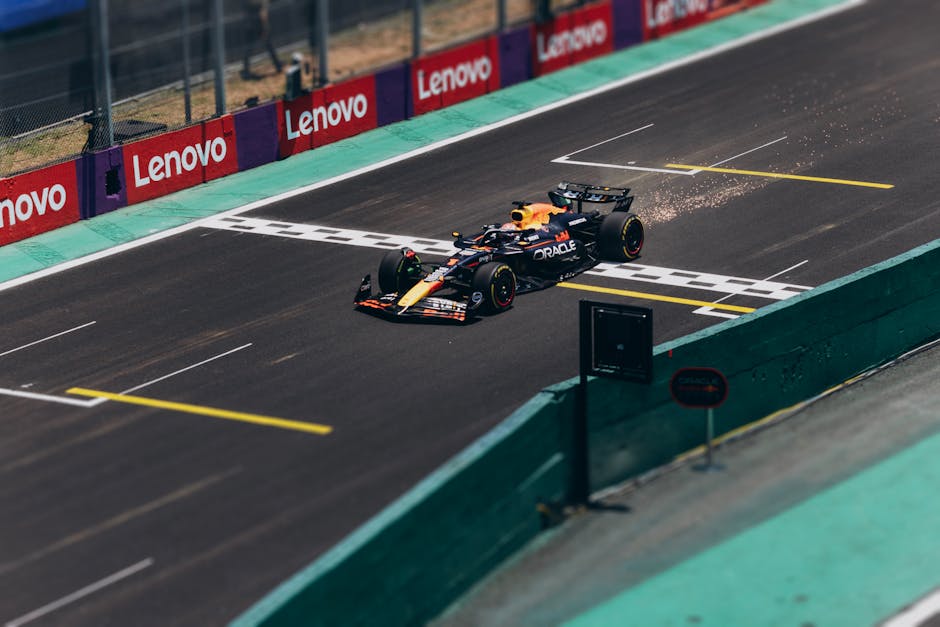
Imagine overtaking a rival without wanting to. That is exactly what happened to Lando Norris at the Japanese Grand Prix in Suzuka. Chasing Lewis Hamilton through the famous 130R corner, Norris’s car deployed its electrical battery boost automatically — he had no say in it. He swept past Hamilton, but immediately found himself with an empty battery on the long straight that followed. Hamilton swept straight back past him. The whole sequence took a matter of seconds, and neither driver was truly in control of it.
That moment captures, in miniature, the central problem with Formula 1’s 2026 regulations. After one of the most ambitious technical overhauls in the sport’s history, drivers are finding that the car sometimes drives them — not the other way around.
What the Yo-Yo Effect Actually Is
The 2026 rules introduced a new power unit architecture with a 50-50 split between the traditional combustion engine and electrical power. That means roughly half of the car’s performance comes from a battery that must be constantly charged and discharged throughout a lap. Drivers now have access to a powerful electrical boost at the push of a button — but that energy is finite, and once it is gone, it takes time to replenish.
The recharging happens mainly under heavy braking and through a technique called “super clipping,” where the electrical motor is briefly run in reverse to harvest energy while the driver stays on full throttle. On circuits where long straights are followed by tight chicanes and then more long straights — like Suzuka — there is simply not enough time to recharge between deployment opportunities. Deploy on one straight, and you have nothing left for the next.
The result is what drivers have taken to calling the yo-yo effect: cars surging past each other on the straights, then falling back just as quickly as batteries run dry. Overtakes happen — sometimes many of them — but they carry no real weight. The driver behind does not need to be brave or clever; they just need to wait for their battery to be fuller than the car ahead.
A Paddock-Wide Complaint
It would be easy to dismiss the criticism as sour grapes from drivers whose cars are not performing well. Max Verstappen, whose Red Bull has struggled badly this season, has been the loudest voice — famously describing the new cars as “Formula E on steroids” as far back as pre-season testing in Bahrain. But the complaints stretch well beyond him.
Norris, despite McLaren clearly being one of the stronger teams in 2026, has said the sport went from the best cars to the worst in a single regulation change. Carlos Sainz, after Japan qualifying, called the situation “not good enough for F1,” arguing that 350 kilowatts of electrical deployment is simply too much for some circuits. Fernando Alonso, never short of a memorable turn of phrase, labelled the Chinese Grand Prix weekend the “battery world championship.” Even the chaotic race starts in Australia, where some drivers arrived at the grid with near-empty batteries and created dangerous speed differentials at lights-out, were traced back to the same underlying problem.
The frustration is not just about the racing spectacle. Norris put it plainly at Suzuka: when a driver is at the mercy of whatever the power unit decides to do, and has no meaningful control over it, something is fundamentally wrong with the formula.
What the FIA Is Doing
The governing body has not been standing still. Ahead of the Japanese Grand Prix, the FIA reduced the maximum permitted battery recharge rate in qualifying from 9 megajoules per lap to 8, hoping to curb the most extreme lift-and-coast behaviour that had been neutering the sport’s most demanding corners. The response from some drivers, including Haas’s Oliver Bearman, was blunt: the tweak was just making them slower.
A broader review meeting was scheduled for after the Japanese Grand Prix, with F1 management, teams, and power unit manufacturers all involved. The options on the table include further reductions in electrical deployment, adjustments to the power ratio between the combustion engine and the battery, and simplifications to the regulatory framework that has created some of the most counterintuitive driving behaviour. None of these are straightforward. Reducing deployment improves driver control but slows the cars — something that generates its own backlash. Changing the fuel-flow rules risks upsetting the competitive balance between manufacturers who have built their entire 2026 programmes around the current parameters.
Great on TV, Broken Inside the Car
There is a genuine split of opinion about whether the 2026 races are actually entertaining. Toto Wolff, the Mercedes team principal, has pointed out that F1 spent years being criticised for too little overtaking — and that some of those now complaining about too many passes should be careful what they wish for. Casual viewers watching the highlights may well enjoy the constant position changes and on-track battles.
But Formula 1 has always sold itself on something deeper than mere spectacle: the idea that the best driver, making the best decisions under pressure, will come out ahead. When overtaking is a function of battery state rather than braking point, racecraft, or bravery, that promise starts to feel hollow. Norris said it himself after Suzuka — the racing can look great on television, but inside the car it is not as authentic as it needs to be.
The season is only three races old. There is time to make adjustments, and the sport’s decision-makers appear to understand the urgency. But the window is narrow — and every race that passes under these conditions risks cementing the perception that F1’s most ambitious regulation change in a decade has produced something that is more video game than sport.
Key Takeaways
- The 2026 power unit rules have created a “yo-yo effect” where cars overtake and are immediately re-passed, driven by battery charge levels rather than driver skill.
- The problem is structural: Suzuka’s layout — long straights with only short corners in between — leaves no time to recharge between deployment opportunities.
- Criticism spans the entire paddock, from Verstappen and Norris to Sainz and Alonso, and includes safety concerns over chaotic race starts in Australia.
- The FIA has made small qualifying adjustments, and a broader review is underway — but the fixes involve difficult trade-offs between driver control, car speed, and competitive balance.
- F1’s credibility rests on the idea that the best driver wins. When battery management outweighs racecraft, that foundation is under threat.
For further reading and viewing on this topic:
- At the mercy of the power unit – Autosport — Norris and Verstappen’s own words after Suzuka.
- F1 2026 – R03 Japan – The New Reality (B Sport, YouTube) — A detailed technical breakdown of the energy management issues after three races.
Photo: Jonathan Borba via Pexels